Exterior care · Residential softwash
Soft Washing Vinyl Siding in Michigan
Compare soft washing and high-pressure washing for Michigan vinyl siding, including cleaning chemistry, water risks, oxidation, and safe prep.
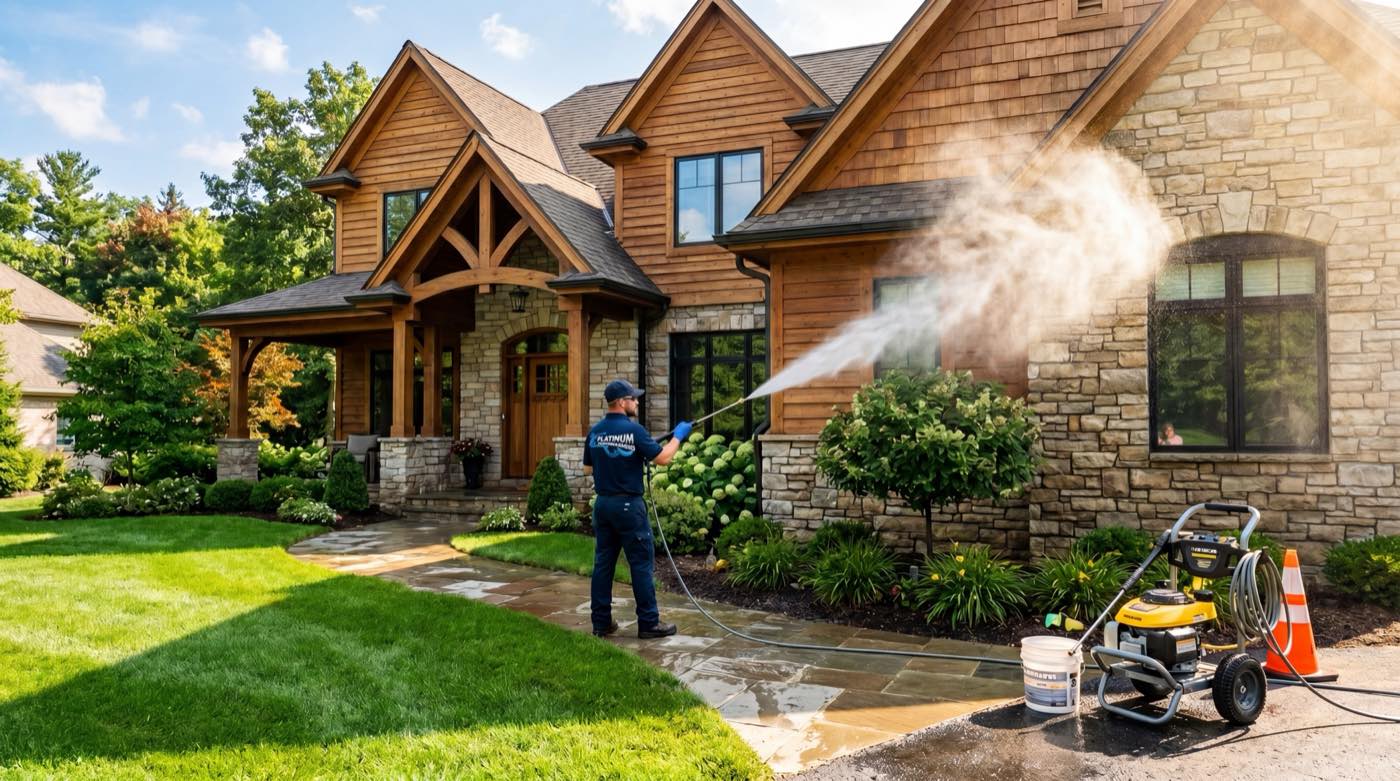
Michigan vinyl siding takes a steady mix of moisture, shade, pollen, road dust, and seasonal temperature swings. North-facing walls may stay damp longer. Areas below trees can collect organic film. Lower courses often catch soil splash. When those surfaces turn green or gray, it is tempting to reach for the strongest pressure available.
That is usually the wrong starting point.
For many vinyl-sided homes, soft washing is the better approach because it asks a compatible cleaning solution to loosen the contamination, gives that solution time to work, and then rinses it away at low pressure. High-pressure washing depends more heavily on impact. Both methods can cause trouble when used carelessly, and the siding manufacturer’s instructions always govern.
Soft washing and pressure washing solve the problem differently
A pressure washer is simply a machine that moves water. Its effect changes with nozzle, flow, distance, angle, and pressure at the surface. With a narrow tip held close to the wall, the stream can cut through grime quickly. It can also leave visible cleaning lines, damage a weathered finish, and send water where rain normally would not go.
Soft washing shifts the work from force to process:
- Inspect the siding, openings, landscaping, and runoff path.
- Apply a siding-compatible cleaner at the labeled dilution.
- Allow controlled dwell time without letting the solution dry.
- Rinse thoroughly with low pressure, generally working in a direction that does not drive water into panel laps.
“Low pressure” does not mean careless spraying, and “soft wash” does not make every chemical suitable. The product label and siding manufacturer’s care instructions determine what can be used, at what concentration, and for how long.
Why chemistry and dwell time matter
The green film seen on shaded siding is not the same as loose dirt. Organic growth can cling to the textured surface and gather around seams. Water impact may strip the visible layer in some spots while missing material in others. That often produces streaks or a patchy finish.
A properly selected cleaner helps break the bond between the soil and the vinyl. Dwell time gives it a chance to act before rinsing. The operator can then use less mechanical force. The goal is not to make a solution stronger than necessary; it is to match the solution, dilution, temperature, and dwell time to the condition while following label directions.
Chemical handling deserves the same care as pressure control. Never mix chemicals casually. Some combinations can release dangerous gases or cause violent reactions. Keep products in labeled containers, use the required protective equipment, and do not improvise a blend. EPA’s Safer Choice program can help consumers identify products whose ingredients meet its safer-ingredient criteria, but certification does not replace the product label or the siding maker’s directions.
Four risks of relying on force
1. Water behind the panels
Vinyl siding is designed to shed water, not form a sealed tank around the house. Its installation depends on details such as a water-resistive barrier, flashing, clearances, and properly treated penetrations. A high-pressure stream aimed upward at laps can drive water behind the siding. Once there, drying depends on the wall assembly and conditions.
2. Water around openings
Windows, doors, light fixtures, vents, outlets, hose bibs, and utility entries interrupt the siding field. Spraying directly into their edges can force water past joints or aging sealant. These areas should be inspected first and rinsed from a controlled angle rather than blasted head-on.
3. Damage to oxidized vinyl
Older vinyl can develop a chalky surface as it weathers. Aggressive pressure or scrubbing may disturb that layer unevenly, leaving wand marks, shiny patches, or a blotchy appearance. Cleaning cannot reverse material aging. A small test in an inconspicuous area helps show how the surface will respond before the whole elevation is treated.
4. Uneven cleaning
A concentrated jet cleans only where it passes. Changes in distance and overlap can create stripes that become obvious after the wall dries. Chemistry, even application, managed dwell time, and a broad low-pressure rinse generally produce a more uniform result on ordinary organic buildup.
A safer plan for a Michigan home
Start by finding the siding brand and its current care instructions when possible. Check for loose panels, cracks, open penetrations, failed sealant, damaged screens, and existing stains. Cleaning should not begin until conditions that could admit water are understood.
Next, test a small, inconspicuous area. A test can reveal oxidation, color change, incompatibility, or uneven response. It also helps establish an appropriate dilution and dwell time. Do not assume that every wall on the house will react identically; sun exposure and age can vary by elevation.
Protect the property before applying cleaner. Close windows and doors. Keep people and pets out of the work zone. Move patio items and sensitive potted plants. Pre-wet nearby vegetation, limit overspray, manage runoff, and rinse foliage with fresh water as permitted by the cleaner’s label. Avoid applying solution when wind could carry mist beyond the intended area or when heat could dry it on the siding.
During rinsing, use controlled volume and low pressure. Work methodically, keep the spray out of upward-facing laps, and give extra care to openings and electrical fixtures. Inspect after the siding dries rather than chasing every shadow with more pressure while it is wet.
Which method should you choose?
For routine algae, mildew-like staining, pollen, and atmospheric soil, a planned soft wash is often the sound choice for vinyl siding. High-pressure impact may have a limited role on other durable surfaces, but it should not be the default answer for a vinyl wall.
The deciding question is not which machine has more power. It is which process can clean the siding while reducing avoidable stress on the panels and limiting unwanted water entry. That means respecting manufacturer instructions, testing first, using compatible chemistry at the proper dilution, controlling dwell time, protecting plants, and rinsing gently.
Learn how our residential softwash service approaches exterior cleaning, or contact Platinum Powerwashing to discuss the siding, access, and conditions at your Michigan home.
Put the field guide to work
Need this handled at your site?
Platinum scopes the work, photographs each stage, and closes out the job with a record your team can file.
Common questions
What facilities teams ask.
Is soft washing safe for all vinyl siding?
No method is automatically safe for every wall. The siding manufacturer's cleaning instructions govern. A technician should identify oxidation, test a small inconspicuous area, use a compatible solution, and keep rinse pressure low.
Can high pressure push water behind vinyl siding?
Yes. A concentrated stream aimed upward, into overlaps, or around windows, doors, vents, and utility penetrations can force water behind panels. Vinyl siding sheds water but is not a watertight exterior system.
Will soft washing remove oxidation from vinyl siding?
Soft washing is intended to remove surface growth and soil, not restore weathered vinyl. Oxidation may appear chalky and can clean unevenly or show wand marks. Test first and set expectations before treating the full wall.
How should plants be protected during a siding wash?
Move sensitive containers, pre-wet nearby plants, control application and runoff, and rinse foliage with fresh water as the product label allows. Never combine cleaning chemicals casually or assume that more concentrate is better.